Although the roll cast is not a Spey cast by itself, it is often included in a sequence of moves that are used for setting up a Spey cast. For instance, when a fly-line is first pulled off the reel and dumped on the water in preparation for fishing, then a roll cast can be employed to straighten the line out downstream, in preparation for one of the Spey casts or an overhead cast.
Also, when a sinking fly-line is used, in deep or fast flowing water, to get down to the fish, then the roll cast can be used very effectively to raise the fly-line to the water’s surface so that a conventional cast can then be made. Sometimes when a long fly-line and/or heavy tube-fly are used, several roll casts might be required to bring the line up to the surface, including if necessary a final jump roll cast.
In addition to these two scenarios, the roll cast is a helpful learning tool because by fully understanding the principles involved in making the roll cast, the novice Spey caster will have a better appreciation of the key requirements for making all Spey casts.
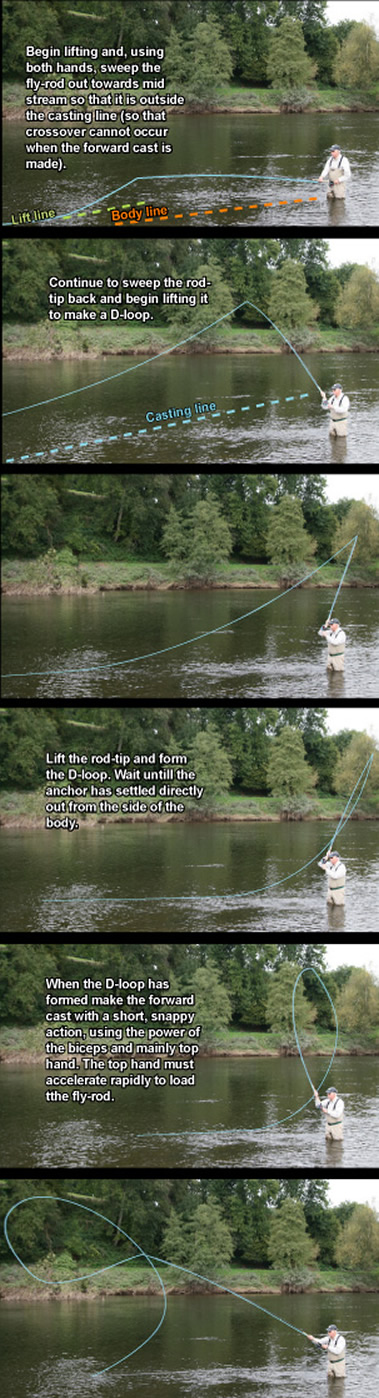
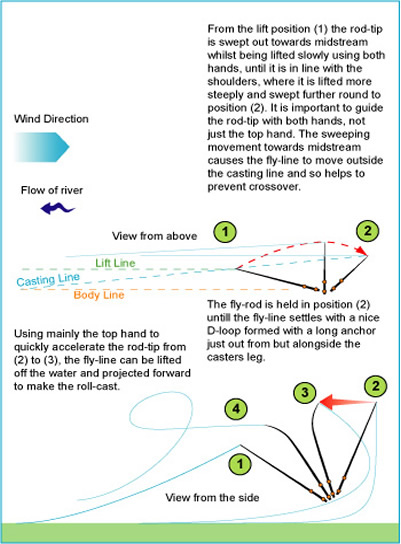
In preparation for the roll cast the body is usually facing downstream along the lift line, even if the feet are facing along the body line. Usually the flow of water will straighten out the fly-line when it is first fed from the reel onto the water, which makes life a little easier. Failing this a token roll cast will assist in straightening the fly-line out. From these preparatory moves it should be now possible to make a lift in the manner described earlier in this book; however, it is not so important with this cast to have tension in the fly-line. Also speed is not of the essence so the lift can be gentle and indeed this is helpful when lifting sinking fly-lines, which require time to emerge, otherwise there will be too much water resistance which will prevent a clean lift.
The hands and hence the rod-tip movements should be such that they take the rod-tip out from the caster, in an arc, whilst the lift is being made. This has two effects; it positions the anchor point outside the casting line and prevents cross-over during the forward cast and it helps to make a slightly bigger D-loop. Eventually this will bring the arms up to the forward casting stance and at this point an even bigger D-loop can be made by taking the rod-tip back further and higher than with the more dynamic Spey casts. Furthermore, this extra movement will help to lift a sunken fly-line and fly.
When the D-loop is completely formed the forward delivery can be made, aiming high and with short, sharp action of both the hands and forearms. The casting arc should be smaller and the stopping position of the rod-tip higher to achieve the best result. Also it is helpful to look at a point which is on the same level as the fly-line is intended to travel during the forward cast.